

Newsletter, Issue 01, September 2026
Wrapping Summer 2026
The first quarterly newsletter: a note from the team, the summer residencies and movie nights, what's coming this fall, and a long conversation with photographer and dancer Gabriela Chavez about Mariposa, her project on grief, color, and film.
A note from the team
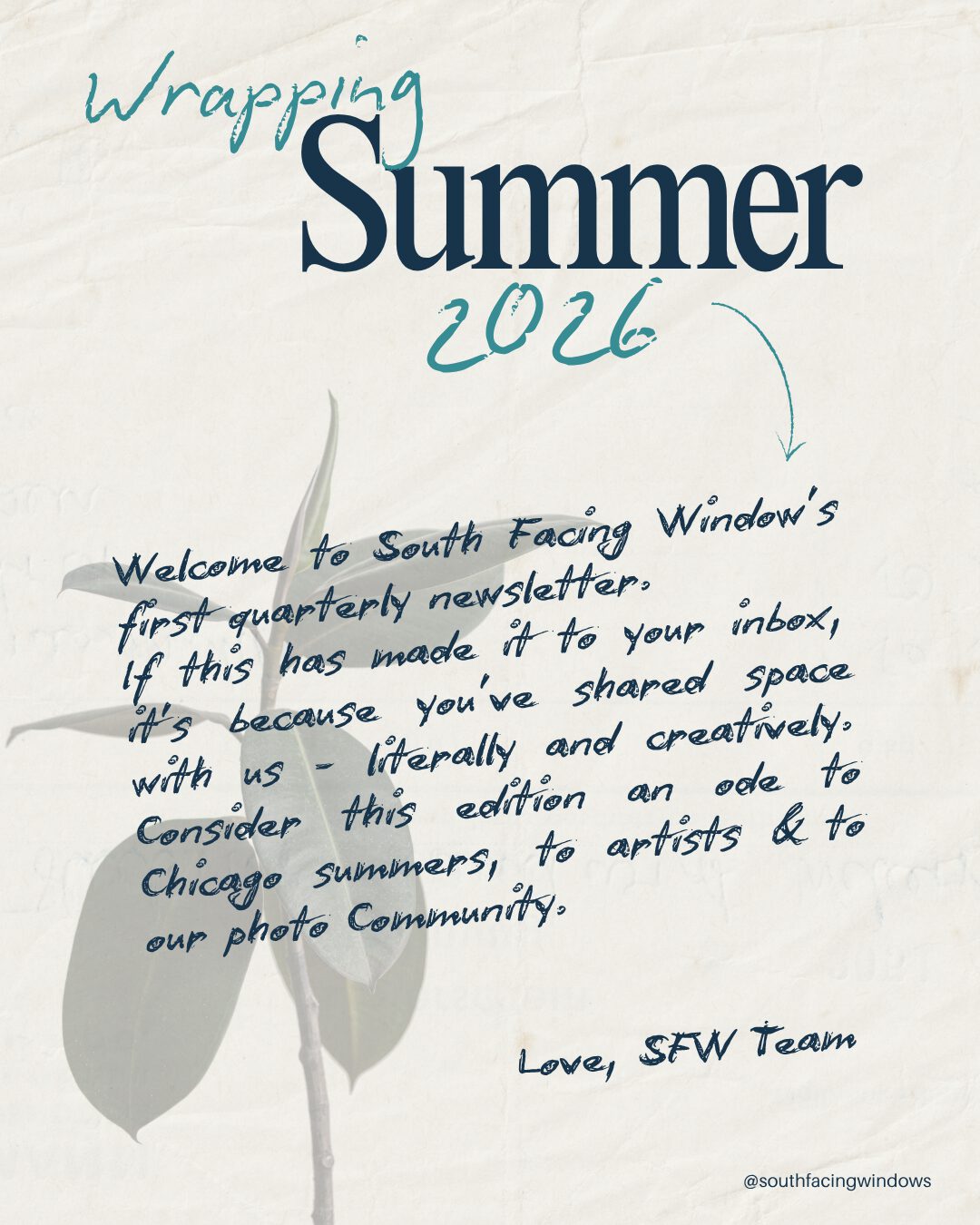
Welcome to South Facing Window's first quarterly newsletter. If this has made it to your inbox, it's because you've shared space with us - literally and creatively. Consider this edition an ode to Chicago summers, to artists & to our photo community.
Love, SFW Team
AIR program and happenings
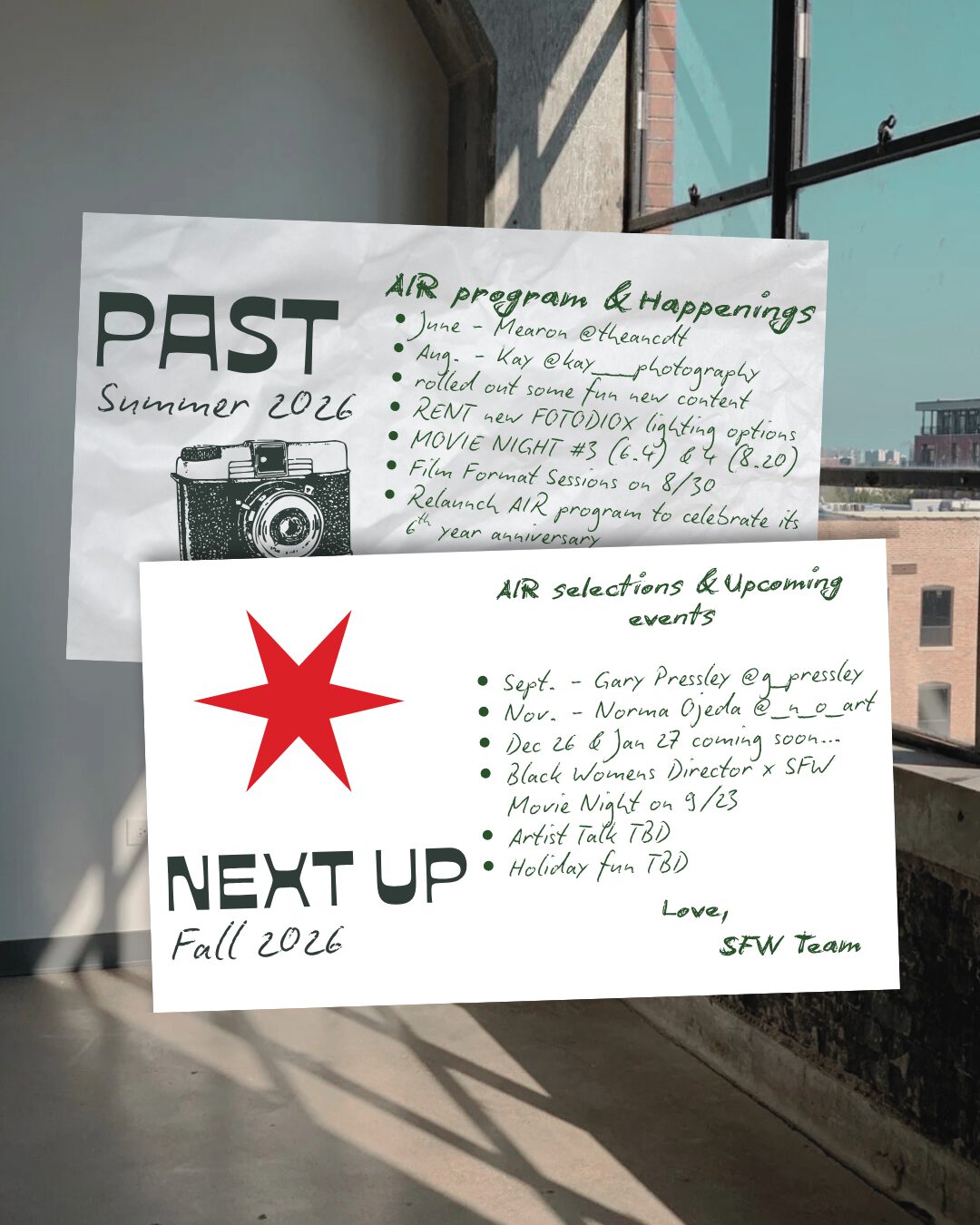
Past: Summer 2026
- June: Mearon (@theancdt)
- August: Kay (@kay___photography)
- Rolled out some fun new content
- Rent: new Fotodiox lighting options
- Movie Night #3 (June 4) and #4 (August 20)
- Film Format Sessions on August 30
- Relaunched the AIR program to celebrate its sixth anniversary
AIR selections and upcoming events
Next up: Fall 2026
- September: Gary Pressley (@g_pressley)
- November: Norma Ojeda (@_n_o_art)
- December and January: coming soon
- Black Womens Director x SFW Movie Night on September 23
- Artist talk: to be announced
- Holiday fun: to be announced
Love, SFW Team
An interview
Gabriela Chavez on Mariposa
As the height of summer creeps up on us, my mind lingers on the reasons why summer is the season that holds the expressions of joy and freedom the most in my heart. Perhaps a nod to childhood nostalgia or the fact that these 4 months are generally a climatic exhale for our city.
The more time I spend, enjoying this summer moment sitting on the Damen blue line stop bench, listening to the rumblings of trains coming and going, the distant humming of car engines below my feet and the occasional soft breeze blowing cool air across the nape of my neck: I realize the people are the ones I love to witness the most.
The doors swing open and the summer dance begins. Each individual pours out onto the platform - their linens, laces, cottons intermingling amongst the air-conditioned draft escaping the train car. Bodies in movement, perfectly choreographing their exit out of the station and onto the street below.
As I also rush down the station's stairs to the coffee shop nearby for my 11 AM meeting with Ecuadorian movement director, dancer and photographer Gabriela Chavez, the romantic in me couldn't help but find this thought around movement and dance so fitting.
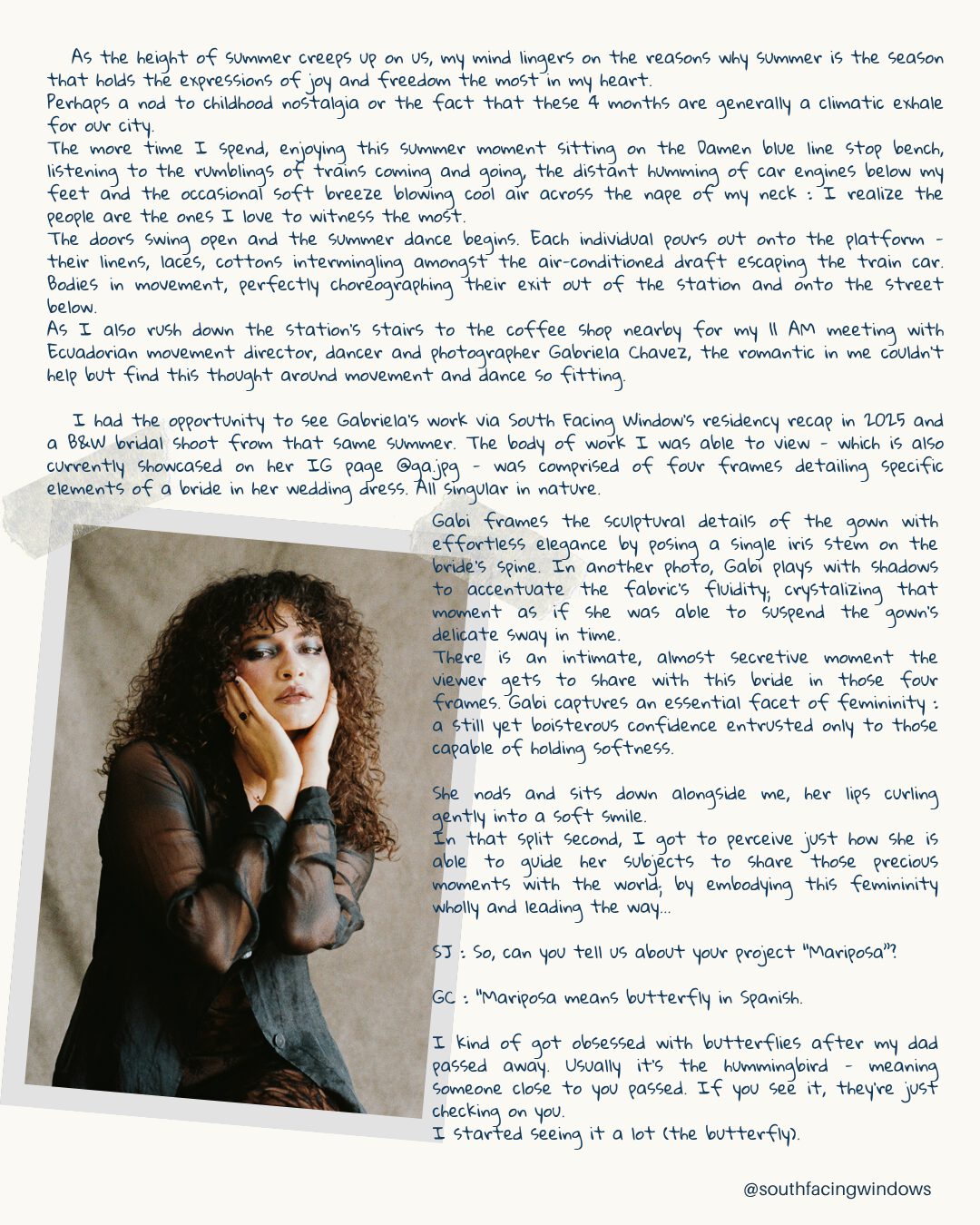
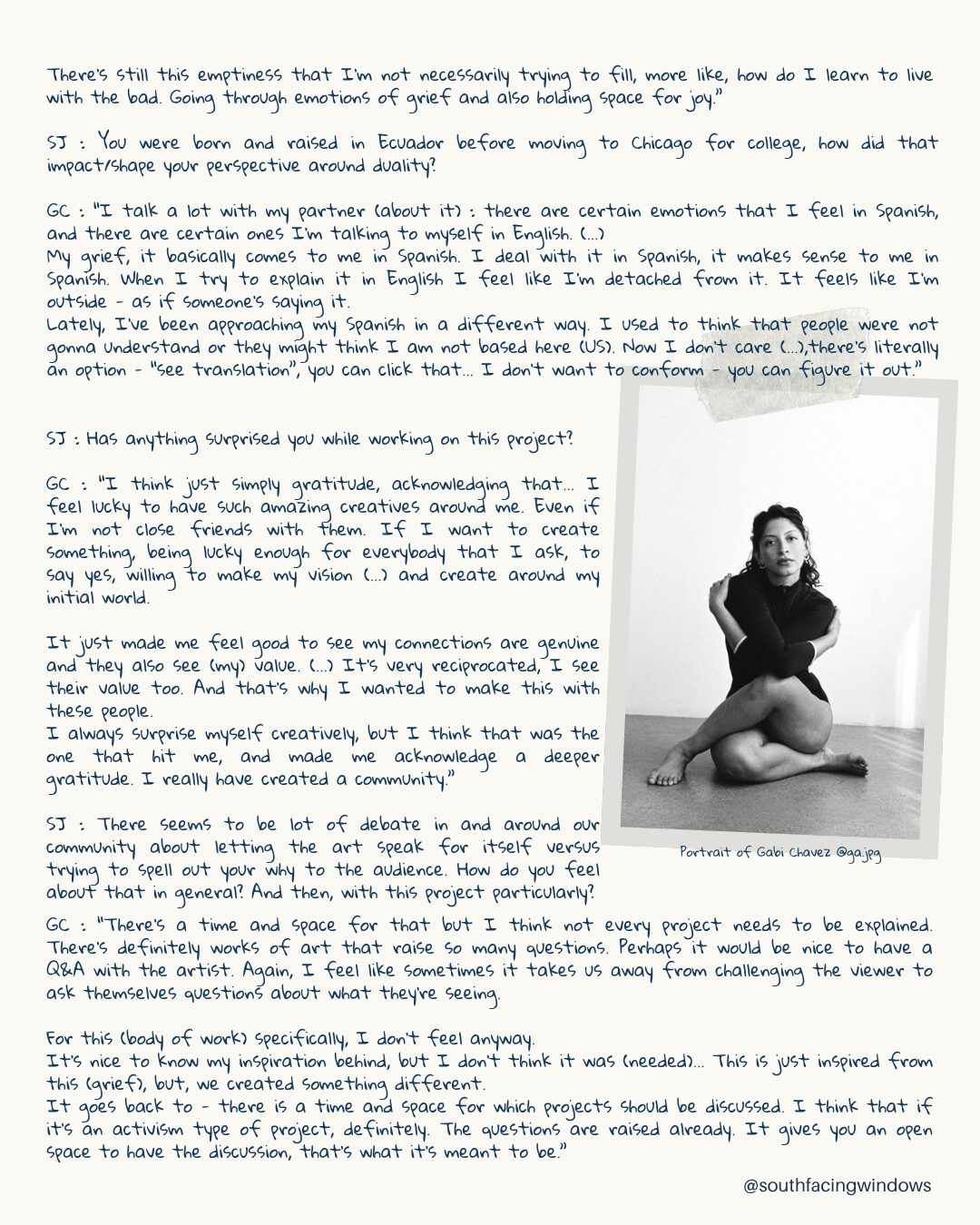
I had the opportunity to see Gabriela's work via South Facing Window's residency recap in 2025 and a B&W bridal shoot from that same summer. The body of work I was able to view - which is also currently showcased on her IG page @ga.jpg - was comprised of four frames detailing specific elements of a bride in her wedding dress. All singular in nature.
Gabi frames the sculptural details of the gown with effortless elegance by posing a single iris stem on the bride's spine. In another photo, Gabi plays with shadows to accentuate the fabric's fluidity; crystalizing that moment as if she was able to suspend the gown's delicate sway in time. There is an intimate, almost secretive moment the viewer gets to share with this bride in those four frames. Gabi captures an essential facet of femininity: a still yet boisterous confidence entrusted only to those capable of holding softness.
She nods and sits down alongside me, her lips curling gently into a soft smile. In that split second, I got to perceive just how she is able to guide her subjects to share those precious moments with the world; by embodying this femininity wholly and leading the way...
So, can you tell us about your project "Mariposa"?
Mariposa means butterfly in Spanish. I kind of got obsessed with butterflies after my dad passed away. Usually it's the hummingbird - meaning someone close to you passed. If you see it, they're just checking on you. I started seeing it a lot (the butterfly).
I looked up the meaning of a butterfly (...) and then I saw one that has similar colors to the ones I chose for this project. I started researching a lot about them and it led me to find the Amazon Beauty (...) They live on the Ecuadorean side of the Amazon forest.
I said yes, this is my butterfly! That's how Mariposa was born.
With the symbolism behind all of that, I was thinking I (would) channel my grief. Not the specifics of what grief is - because (..) you only experience (grief) once you go through it. You can read about it, you can see it through (...) people close to you... But, it truly hits you when you're the one feeling it. You never know how you're gonna handle it. I've seen so many people channel their current emotions or situations in a more literal way. I didn't want to fully expose myself like that. I'd rather use this without it truly being a representation of the dark side of grief.
What were your technical, creative processes when you decided to build out Mariposa?
I feel like every project is trial and error. I've always wanted to get into film because I know for sure that's how you can actually challenge your own skills and challenge your eye (as a photographer). Also, (the challenge became) transforming my own grief in an indirect way, instead of focusing on the storytelling of grief.
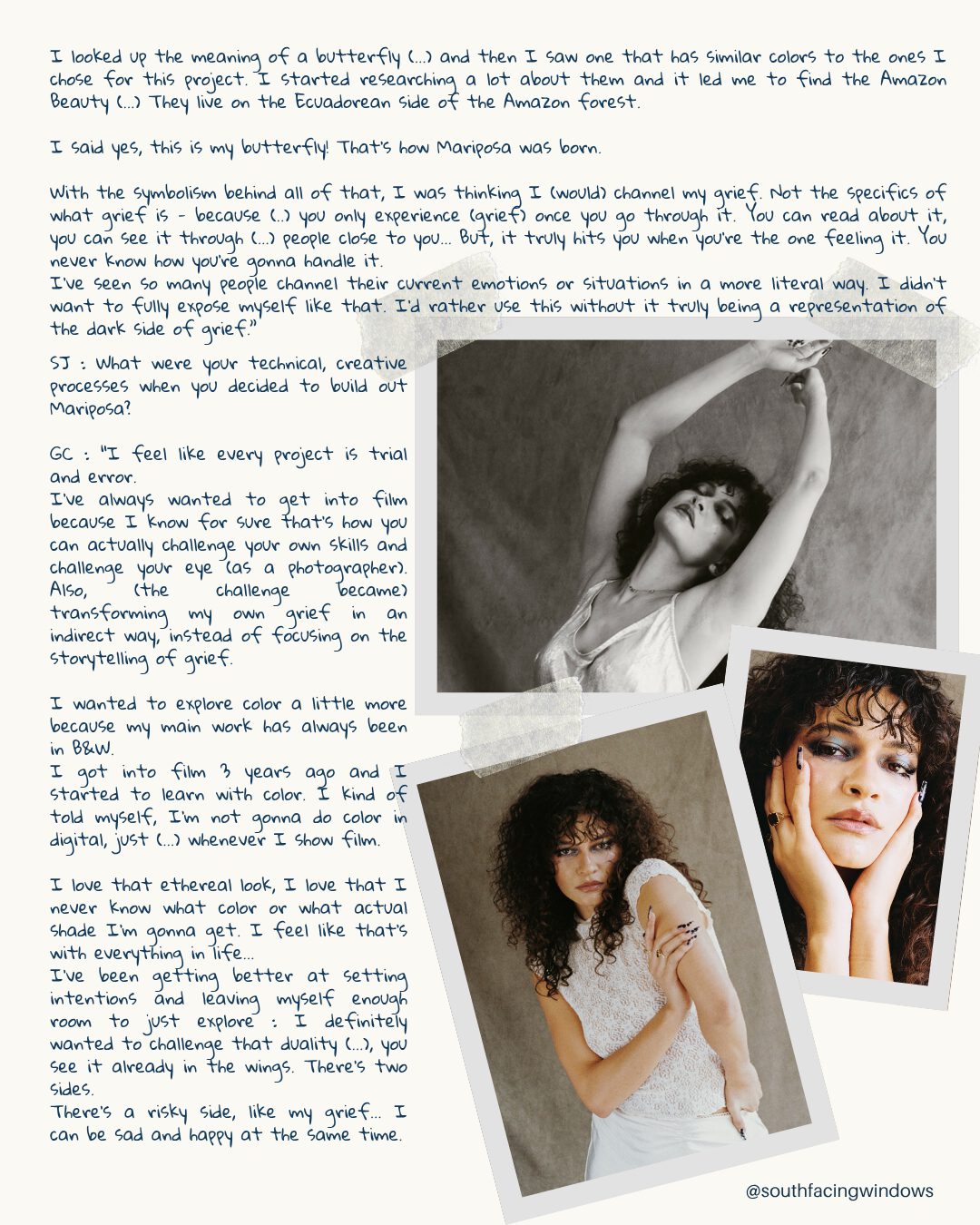
I wanted to explore color a little more because my main work has always been in B&W. I got into film 3 years ago and I started to learn with color. I kind of told myself, I'm not gonna do color in digital, just (...) whenever I show film.
I love that ethereal look, I love that I never know what color or what actual shade I'm gonna get. I feel like that's with everything in life... I've been getting better at setting intentions and leaving myself enough room to just explore: I definitely wanted to challenge that duality (...), you see it already in the wings. There's two sides. There's a risky side, like my grief... I can be sad and happy at the same time. There's still this emptiness that I'm not necessarily trying to fill, more like, how do I learn to live with the bad. Going through emotions of grief and also holding space for joy.
I can be sad and happy at the same time.
You were born and raised in Ecuador before moving to Chicago for college, how did that impact/shape your perspective around duality?
I talk a lot with my partner (about it): there are certain emotions that I feel in Spanish, and there are certain ones I'm talking to myself in English. (...) My grief, it basically comes to me in Spanish. I deal with it in Spanish, it makes sense to me in Spanish. When I try to explain it in English I feel like I'm detached from it. It feels like I'm outside - as if someone's saying it. Lately, I've been approaching my Spanish in a different way. I used to think that people were not gonna understand or they might think I am not based here (US). Now I don't care (...), there's literally an option - "see translation", you can click that... I don't want to conform - you can figure it out.
Has anything surprised you while working on this project?
I think just simply gratitude, acknowledging that... I feel lucky to have such amazing creatives around me. Even if I'm not close friends with them. If I want to create something, being lucky enough for everybody that I ask, to say yes, willing to make my vision (...) and create around my initial world.
It just made me feel good to see my connections are genuine and they also see (my) value. (...) It's very reciprocated, I see their value too. And that's why I wanted to make this with these people. I always surprise myself creatively, but I think that was the one that hit me, and made me acknowledge a deeper gratitude. I really have created a community.
There seems to be lot of debate in and around our community about letting the art speak for itself versus trying to spell out your why to the audience. How do you feel about that in general? And then, with this project particularly?
There's a time and space for that but I think not every project needs to be explained. There's definitely works of art that raise so many questions. Perhaps it would be nice to have a Q&A with the artist. Again, I feel like sometimes it takes us away from challenging the viewer to ask themselves questions about what they're seeing.
For this (body of work) specifically, I don't feel anyway. It's nice to know my inspiration behind, but I don't think it was (needed)... This is just inspired from this (grief), but, we created something different. It goes back to - there is a time and space for which projects should be discussed. I think that if it's an activism type of project, definitely. The questions are raised already. It gives you an open space to have the discussion, that's what it's meant to be.
If you could have dinner with someone that was most influential to you - that shaped who you became as a person, as an artist... Who would that person be?
Note to the reader: for obvious reasons it was terribly hard to choose just one. We settled on top 5 but only got to 4.
Definitely Gordon Parks. (...) Prince, David Bowie. I think they just channel - outside of their main one which is music - art itself. They were beyond their time too: (...) very bold, especially, in our society that's still very close-minded right now. I can't imagine back in that time either... Vivian Maier too, I would like to pick her brain: why she never wanted to (develop her pictures)... She never saw them... There is a fine line. I want to know, but I don't want to know because I don't want to break the magic in it. I'm more interested in their wisdom, the development, rather than how do you do this? At the end of the day, art is always fueled by some phase in your life, some situation that you're going through, emotions that you don't know how to handle that give birth to this masterpiece or whatever. No one can teach you the storytelling, that has to come from you. There's no way to tell a story. You choose how you want to tell it.
What's next for you - what are you currently working on?
Right now, working on some portrait sessions. And just wrapped working with Nolis, he hosted a workshop for Leica, and I was the dancer and subject. It was a fun interactive workshop. He asked me and I was like - improv? Sign me up. That's my dream life.
Any last thoughts you want to share about you or your work?
Just stay true to yourself.
She replied casually, shrugging her shoulders. Life advice that we can sometimes underestimate, thinking it's "too simple", "so cliché" because it's on every Etsy shop coffee mug or in the caption of someone's latest proof of life carousel. Yet, the permanence and authenticity of it can't be ignored.
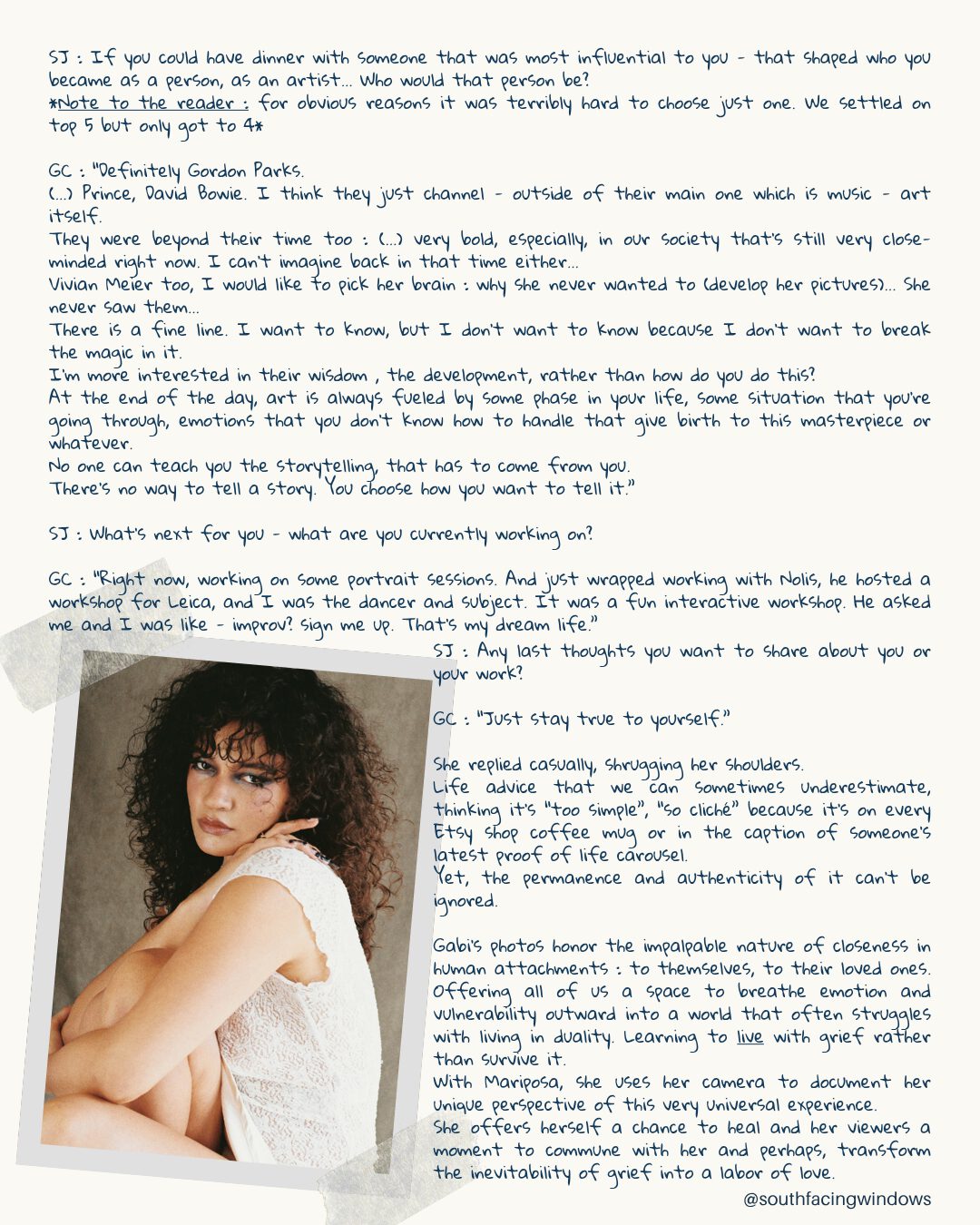
Gabi's photos honor the impalpable nature of closeness in human attachments: to themselves, to their loved ones. Offering all of us a space to breathe emotion and vulnerability outward into a world that often struggles with living in duality. Learning to live with grief rather than survive it. With Mariposa, she uses her camera to document her unique perspective of this very universal experience. She offers herself a chance to heal and her viewers a moment to commune with her and perhaps, transform the inevitability of grief into a labor of love.
Interview by SJ. Portraits of Gabi Chavez, @ga.jpg.
Join our mailing list
Get our quarterly newsletter, studio updates, and upcoming events sent right to your inbox.